Log in To see your account pricing.
Need bulk, customized or optimized products for commercial purposes? We also offer support with logistics, compliance and more. Reach out to cooperate with QIAGEN Strategic Partnerships & OEM
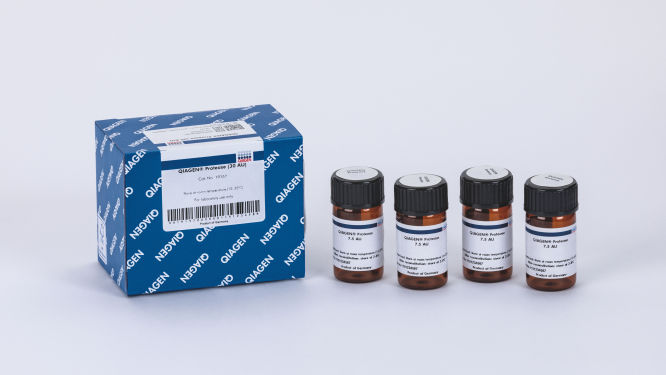
QIAGEN Protease (30 AU)
Cat no. / ID. 19157
4 x 7.5 Anson units per vial (lyophilized)
Enzyme
QIAGEN Protease
QIAGEN Proteinase K (RUO)
QIAGEN Protease Solvent
QIAGEN Proteinase K
Proteinase K - Powder
Contains
30 (4 x 7.5) AU
7.5 AU
Need bulk, customized or optimized products for commercial purposes? We also offer support with logistics, compliance and more. Reach out to cooperate with QIAGEN Strategic Partnerships & OEM
Features
- For protease digestion in DNA and RNA isolation procedures
- Fully compatible with selected QIAGEN protocols
- Enzymes quality-guaranteed by QIAGEN
Product Details
QIAGEN Protease and QIAGEN Proteinase K offer broad substrate specificity with high activity for a wide range of reaction conditions. QIAGEN Proteinase K in 2 mL and 10 mL pack sizes is dedicated for use in various QIAGEN kits (please see list in the Principle section below). As a sample prep expert, QIAGEN also offers Proteinase K as lyophilized powder (Proteinase K Powder). Both proteases offer high activity in buffers commonly used in most DNA and RNA isolation procedures and are quality-guaranteed by QIAGEN.
Performance
QIAGEN Protease and QIAGEN Proteinase K
QIAGEN Protease and QIAGEN Proteinase K offer broad substrate specificity with high activity in buffers commonly used in most DNA and RNA isolation procedures. Both enzymes are quality-guaranteed by QIAGEN.
QIAGEN Protease is particularly stable and active at high pH. In Tris-containing buffers of alkaline pH (7.5–10.5) QIAGEN Protease displays 30 to 40% higher specific activity than Proteinase K.
In the presence of strong denaturants, such as urea (0.75–3 M urea) or guanidine HCl (0.5–3.0 GuHCl), the specific activity is comparable to that of Proteinase K, provided the EDTA concentration is less than 8 mM.
QIAGEN Protease shows increased activity in the presence of urea and guanidine HCl. Similar stimulation is obtained upon the addition of up to 1% SDS. Enzymatic activity also increases as a function of
temperature (30–55°C). For more detailed information, refer to the QIAGEN Protease Product Sheet in the Resources section.
The enzyme can be easily inactivated by incubation at 70°C for 15 minutes.
QIAGEN Protease is not inhibited by up to 100 mM EDTA in Tris·Cl buffers. However, in the presence of greater than 1% SDS or other strong denaturants, the EDTA concentration must be less than 8 mM.
Proteinase K powder
Proteinase K powder is a lyophilized, white powder, highly active with exceptional lot-to-lot consistency (see figure “High lot-to-lot consistency Proteinase K powder”), ensuring reproducibility for stable working conditions, repeatable and reliable experiment results. Proteinase K powder is highly stable when stored at -20°C (see figure “Proteinase K powder stability”).
Proteinase K powder specifications:
- No detected exonuclease, endonuclease or RNase activity
- Solubility in water ≥20 mg/mL; activity ≥30 U/mg lyophilizate; specific activity ≥40 U/mg protein; protein content ≥70%; DNA content ≤10 pg/mg
- Shipping conditions: Ambient temperature
Principle
Technical specifications
| QIAGEN Protease | QIAGEN Proteinase K | Proteinase K Powder | |
|---|---|---|---|
| Format | Lyophilized powder | Ready-to-use solution | Lyophilized powder |
| Amount | 7.5 AU or 4 x 7.5 AU | 2 mL or 10 mL (20 mg/mL) | 20 mg, 100 mg, 250 mg, 1 g, 10 g, 25 g, 50 g, 200 g |
| Activity | 45 mAU/mg protein | >600 mAU/mL | ≥30 U/mg lyophilizate ≥40 U/mg protein |
| Unit definition | One mAU is the activity that releases folin-positive amino acids and peptides corresponding to 1 µmol tyrosine per minute | One unit of Proteinase K hydrolyzes urea-denatured hemoglobin producing the color equivalent of 1 μ mol tyrosine per 1 minute at 37°C and pH 7.5 (Folin & Ciocalteu’s method), 1 U = 1 mAnsonU | |
QIAGEN Proteinase K (in 2 mL and 10 mL pack sizes) is a subtilisin-type protease isolated from the saprophytic fungus Tritirachium album and is particularly suitable for short digestion times. It possesses a high specific activity that remains stable over a wide range of temperatures and pH values with substantially increased activity at a higher temperature. Soluble calcium is not essential for enzymatic activity. This means that EDTA, which is used to inhibit Mg2+-dependent enzymes, such as nucleases, will not inhibit Proteinase K activity. Proteinase K is supplied in the following QIAGEN kits:
- QIAamp DNA Mini Kit
- QIAamp Fast DNA Stool Mini Kit
- DNeasy Blood & Tissue Kit
- DNeasy 96 Blood & Tissue Kit
- QIAamp DNA Micro Kit
- QIAamp MinElute Media Kit
- QIAamp Media MDx Kit
QIAGEN Protease is a serine protease isolated from a recombinant Bacillus strain. It is an economical alternative to Proteinase K for isolation of native DNA and RNA from a variety of sources. QIAGEN Protease is completely free of DNase and RNase activities. QIAGEN Protease is supplied in the following QIAGEN kits:
- QIAamp DNA Blood Mini, Midi and Maxi Kits
- QIAamp 96 DNA Blood Kit
- Blood & Cell Culture DNA Kits
- QIAamp Virus BioRobot 9604 Kit
- QIAamp DNA Blood BioRobot MDx Kit
- QIAamp DSP Virus Kit
- QIAamp DSP DNA Blood Mini Kit
Note: Users of manual QIAamp DNA Blood Kits and QIAGEN Blood & Cell Culture DNA Kits should resuspend each bottle of QIAGEN Protease with 7 mL distilled water.
Note: Users of the QIAamp DNA Blood BioRobot 9604 Kit should resuspend each bottle of QIAGEN Protease with 10 mL distilled water.
Note: QIAGEN Protease is not compatible with Buffer ATL in the DNeasy Tissue, DNeasy 96 Tissue and QIAamp DNA Mini Kit. In the presence of >0.5% SDS, >1% sarkosyl or high concentrations of other detergents, the EDTA concentration must be <8 mM for full activity over extended incubation times.
Procedure
Instructions for using QIAGEN Protease, QIAGEN Proteinase K and Proteinase K Powder are provided in the corresponding kit handbook.
Applications
QIAGEN Protease, QIAGEN Proteinase K and Proteinase K Powder provide protease digestion during DNA and RNA preparation. Subtle differences between the enzymes should be considered when planning protease digestions.